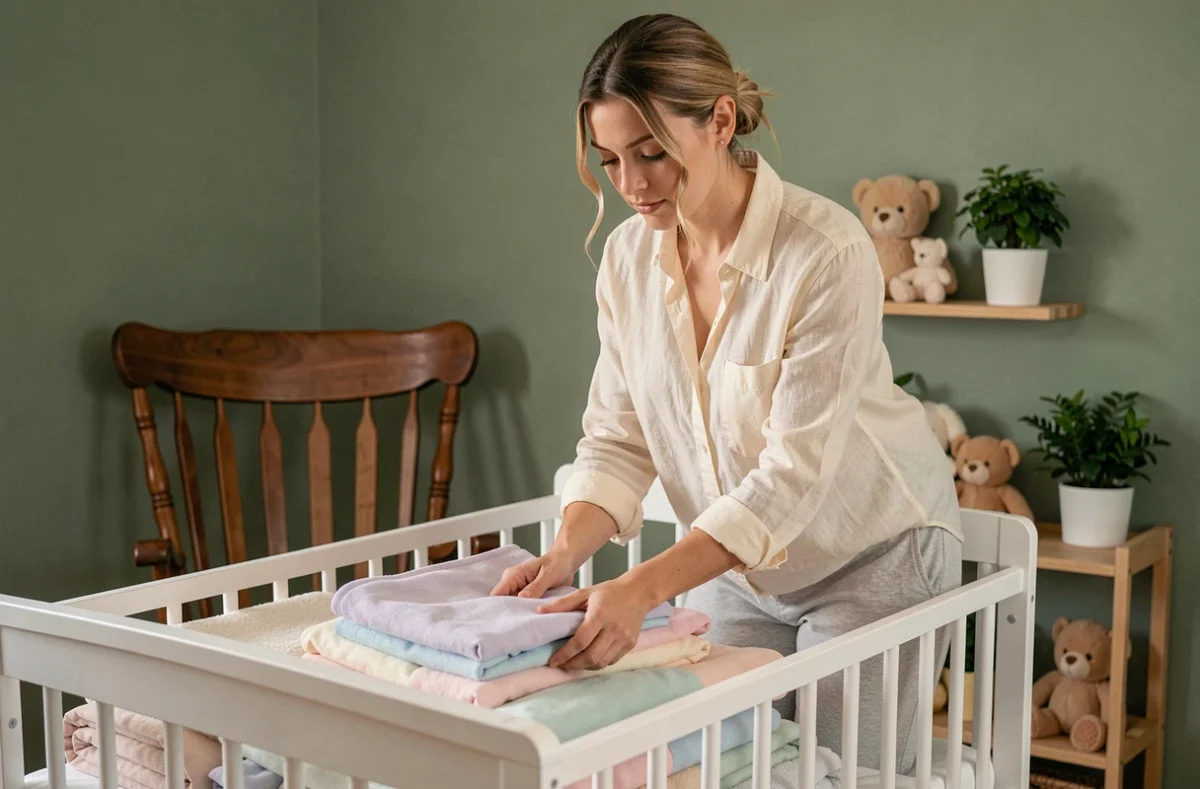
Setting up the baby’s room before their arrival involves balancing sleeping safety, air quality, and furniture functionality. French recommendations remind us that the infant sleeps in the parents’ room for the first six months, in their own bed. The dedicated room is therefore prepared in advance, but it will only become the main sleeping space later.
1. Plan the work several weeks before the birth
Paints, glues, and varnishes release volatile organic compounds (VOCs) for several days after application. To limit the newborn’s exposure, the work in the room should be completed at least one month before the expected delivery date.
Ventilating the room thoroughly every day after the construction work helps reduce the residual concentration of pollutants. When you want to prepare the baby’s room with Maman m’adore, this work schedule is one of the first reflexes to adopt.
2. Choose A+ rated materials for indoor air quality
The label “Indoor Air Emissions” appears on construction and decoration products sold in France. Only the A+ rating guarantees the lowest level of VOC emissions. This label applies to wall paint, flooring, particle board used in furniture, and adhesives.
Checking this label on each product purchased for the room reduces the risk of respiratory irritation in the infant. Unfinished solid wood furniture or low-emission labeled products are a reliable alternative to standard particle boards.
3. Select a firm mattress that fits the bed perfectly
The mattress must fit the bed perfectly, with no space between the edge of the mattress and the walls. A gap, even of a few centimeters, creates a risk of entrapment for the infant.
The firmness of the mattress is a safety criterion, not a comfort one in the adult sense. A mattress that is too soft increases the risk of face burying. Choosing a model certified for infant sleeping remains the most direct method to avoid mistakes.
4. Clear the bed of any unnecessary accessories
The baby’s bed should contain only three elements: the mattress, a fitted sheet, and the baby themselves. Pillows, blankets, comforters, bumpers, and stuffed animals are not recommended in the sleeping space. This rule often contradicts decor inspiration photos, which show beds adorned with textile accessories.
To cover the infant at night, a seasonally appropriate sleeping bag replaces the blanket. It limits the risks associated with loose fabrics in the bed while maintaining a stable temperature.
5. Install the changing table at an ergonomic height
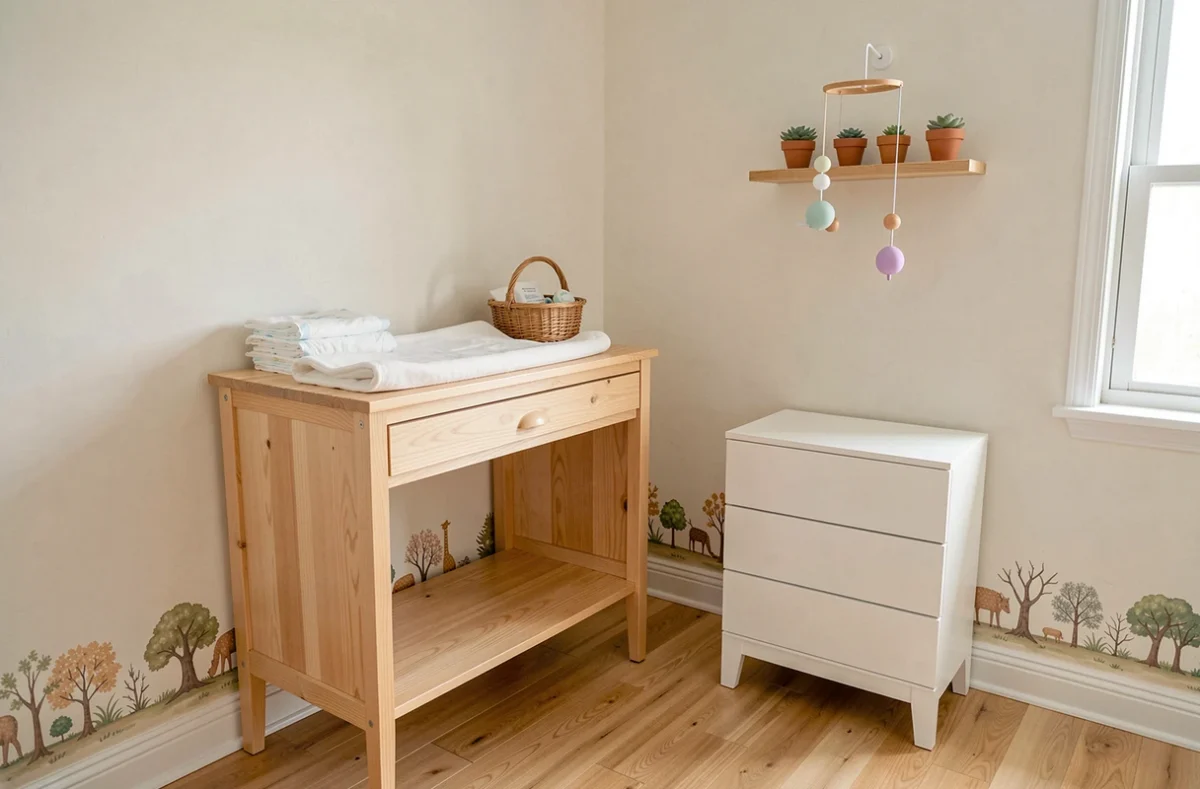
The changing table is used several times a day during the first months. Its height should allow the parent to change the baby without bending over, which prevents chronic back pain. A changing dresser combines storage and changing space in one piece of furniture, a valuable space saver in a small room.
Placing diapers, cotton, and care products within direct reach avoids taking your eyes off the baby during the change. Never leave an infant unattended on a changing table, even for a second.
6. Prefer soft and adjustable lighting
The lighting in the baby’s room serves two distinct functions: general lighting for care and storage, and dim lighting for nighttime awakenings and falling asleep.
A dimmable nightlight, placed away from the bed, is sufficient for nighttime interventions without stimulating the infant’s wakefulness. Warm light bulbs (low color temperature) are preferable to cold white lights in a sleeping space.
7. Control the temperature and ventilation of the room
The recommended temperature for a newborn’s room is around 18 to 20 degrees. An indoor thermometer mounted on the wall, away from the radiator, provides a reliable reading. Overheating the room remains one of the most common mistakes.
Ventilating the room for at least ten minutes a day, with the window wide open, renews the air and expels humidity. During cold periods, ventilating in the morning before putting the baby back in the room helps quickly restore a stable temperature.
8. Secure tall furniture to the wall for safety
A shelf, bookcase, or wardrobe that is not secured can tip over as soon as the child begins to pull themselves up. Even if the newborn is not yet mobile, securing furniture to the wall during the initial setup prevents forgetting this critical step a few months later.
Wall anchoring kits are inexpensive and fit most furniture. Checking that the drawers of the changing dresser have an anti-tip system is part of the same preventive reflex.
9. Plan for storage accessible without leaving the changing area
The organization of storage should be thought out based on repetitive actions: changing, dressing, putting to bed. Daily clothes, spare bodysuits, and sleeping bags should be stored in open compartments or labeled baskets, accessible with one hand.
- Diapers and changing essentials are stored in the top drawer of the dresser or on a wall shelf above the changing area.
- Everyday clothes occupy the middle drawers, sorted by type (bodysuits, pajamas, socks).
- Less frequently used items (clothes for the next season, spare linens) go in lower storage or a closed trunk.
This organization reduces trips back and forth and limits the time the baby spends alone on the changing table.
10. Delay non-functional decoration
Painting the walls in neutral tones and laying down an easy-to-clean floor cover basic decorative needs. Wall stickers, frames, and string lights can wait until the room is settled into daily use, once the real needs are identified.
Decorative objects placed above or near the bed present a risk of falling. A mobile, if installed, must remain out of the baby’s reach and be securely attached to the ceiling or a wall support, never to the bed itself.
The most successful baby room is one where each element serves a concrete purpose. The first months reveal needs that planning alone may not always anticipate, and leaving room to adjust the layout after birth remains the most pragmatic strategy.