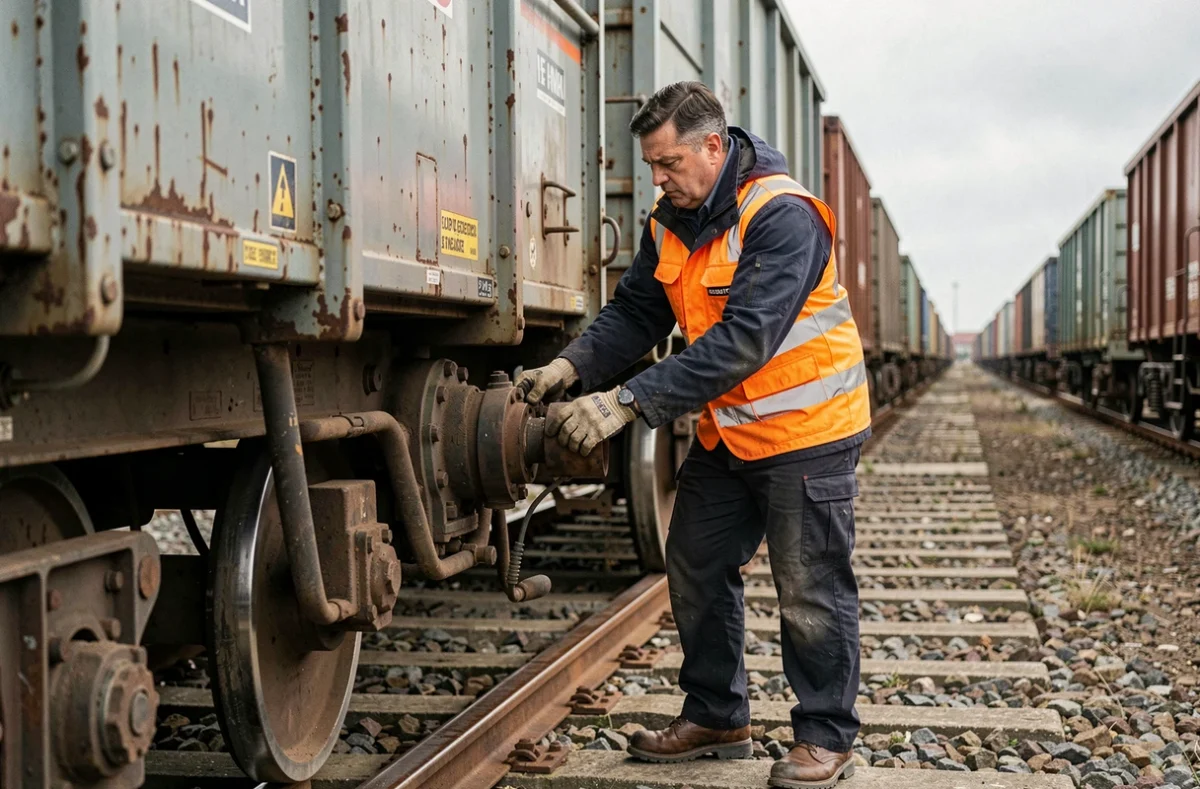
The wagon inspector, also known as a wagon examiner, works on the tracks at marshalling yards and freight terminals. Their role is to inspect each wagon before a train departs, checking the running gear, braking systems, couplings and the overall condition of the body.
In Europe, the regulatory framework for entities in charge of maintenance (ECMs) governs the maintenance of railway vehicles. However, the European Union Agency for Railways clearly distinguishes pre-departure inspections—which fall under the railway undertaking’s safety management system—from maintenance work carried out in a workshop. This division of responsibilities shapes the day-to-day work of the role.
Wagon unfit to depart: the decision-making chain involving four parties
When a wagon inspector spots a defect on a wagon (a crack in a side sill, a seized brake or a damaged axle), they do more than simply attach a label. They initiate a procedure involving up to four separate parties, each with its own obligations.
The employee who identifies the defect files a report in their railway undertaking’s information system. The report describes the nature of the problem, its location on the wagon and its estimated severity. The railway undertaking then decides whether the wagon can operate under restrictions (reduced speed, routing to a workshop) or must be immobilised on site.
The wagon’s keeper, often a leasing company or a freight operator other than the undertaking providing traction, is notified. The keeper appoints the entity in charge of maintenance (ECM) to arrange the repair. The maintenance workshop then carries out the work according to specifications set by the ECM. Understanding the work of a wagon inspector means understanding this division of responsibilities: the employee on the ground identifies the defect, but does not decide alone what happens to the wagon.
Information-sharing between these parties remains a source of friction. A poorly classified defect or a report sent late can leave a wagon immobilised for several days, block a train path and disrupt an entire terminal.
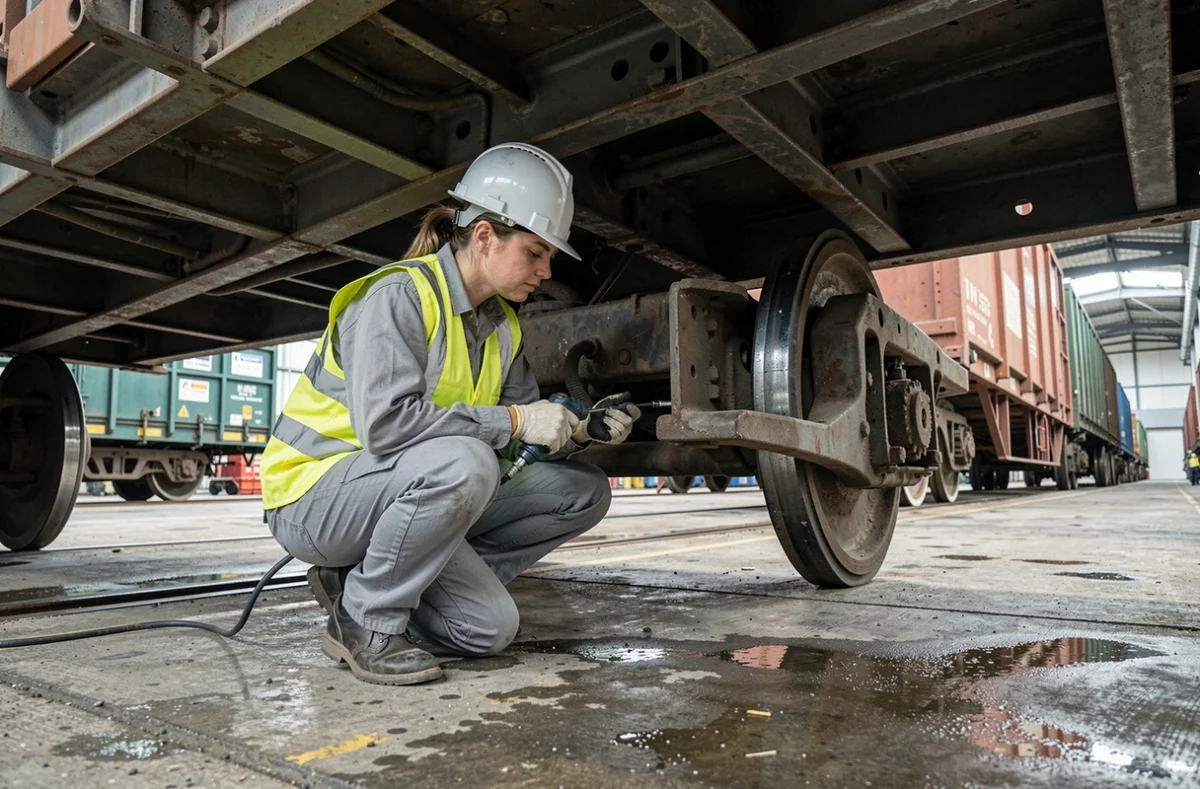
Pre-departure inspection and maintenance: two distinct approaches in the field
Inspection and maintenance are often confused, including in job listings for wagon inspectors. Both activities require similar mechanical skills, but they are governed by separate regulatory frameworks.
- A pre-departure inspection is an operational check carried out under the railway undertaking’s responsibility as part of its safety management system. It assesses whether the wagon is immediately fit to run: the condition of the brakes, couplings and buffers, and whether there is any visible damage to the body or chassis.
- Scheduled maintenance (preventive or corrective) is managed by the wagon’s ECM. It follows a maintenance plan specific to each vehicle type and may include major work, such as replacing axles or overhauling bogies, carried out in a specialist workshop.
- The European Agency’s first evaluation report on the ECM Regulation confirms that maintenance certification now covers all railway vehicles, not just freight wagons. This extension harmonises requirements across Europe, but also adds administrative complexity for employees in the field.
For a wagon inspector, this distinction means they cannot carry out repairs themselves when a defect falls under maintenance, even if they have the technical skills to do so. Their role ends with diagnosis and the decision on whether the wagon is fit to run. This framework safeguards the traceability of work, but can be frustrating when a wagon remains immobilised over a problem the inspector knows how to fix.
Working conditions in marshalling yards
Wagon inspectors spend much of their working day outdoors, among the tracks of a marshalling yard. The physical demands are real: walking for long periods on ballast, inspecting beneath wagons while crouching or lying down, and working in all weather throughout the year.
Work is organised around shift patterns, with frequent night shifts. Freight terminals operate continuously to meet the train paths allocated by the infrastructure manager. A delay in inspecting a batch of wagons can push back a train’s departure and trigger a domino effect across the entire transport plan.
Time pressure is the role’s most constant challenge. Inspectors must balance thorough checks with the pace set by traffic planning. Cutting inspection time to keep to schedule creates a safety risk. Taking the time needed can disrupt operations.
Technological developments in wagon fleets
Some operators are gradually equipping their fleets with telematics sensors that record GPS coordinates and data on impacts sustained by wagons. These systems can pinpoint an event (a severe impact or minor derailment) even before a visual inspection. The wagon inspector can then use this preliminary diagnosis to guide their checks.
This development does not eliminate physical inspections, but it changes the order of priorities. Wagon inspectors are moving from uniform, systematic checks to targeted inspections guided by sensor alerts. The ability to interpret data is becoming an additional skill alongside traditional mechanical expertise.
Rail freight in France: a context of growing workloads
The SDES 2025 Annual Transport Report records growth in rail freight activity, driven in particular by intermodal transport, while overall land freight transport declined. This trend supports a broader government objective: to double rail’s modal share of freight transport by 2030, according to a report finalised in February 2024 and cited by IGEDD.
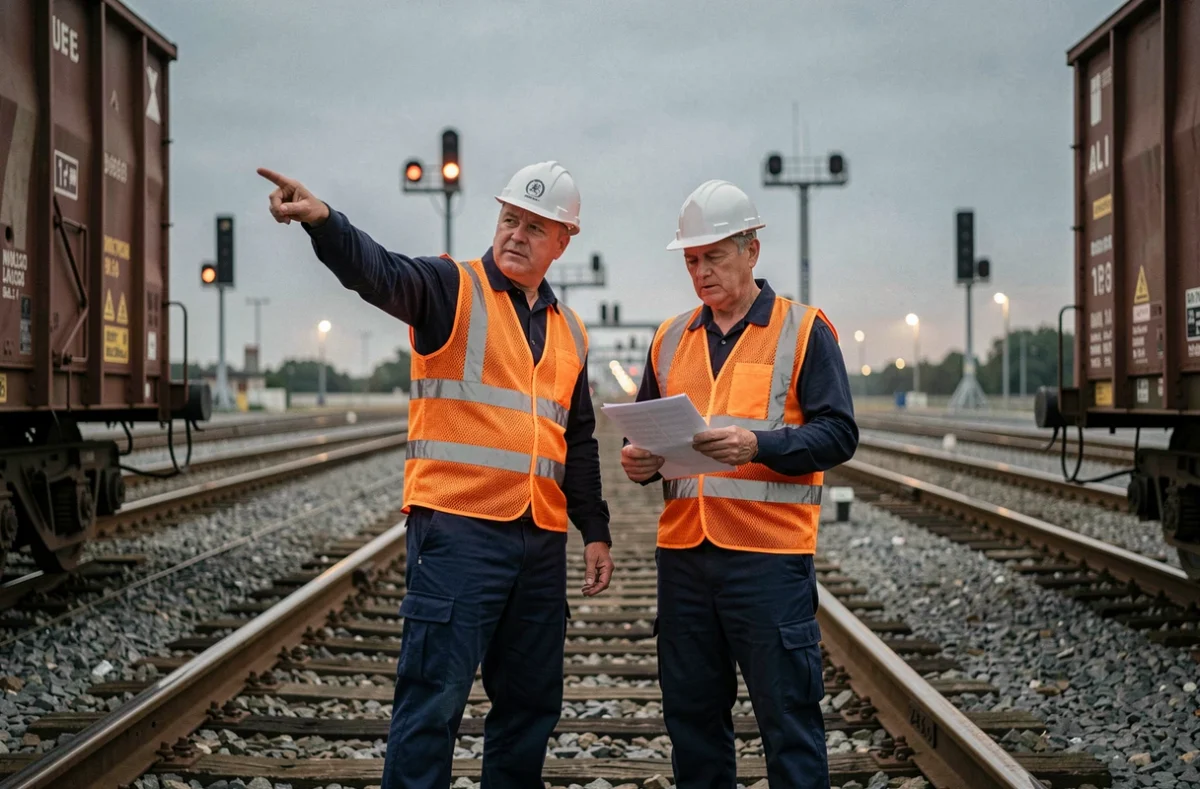
For wagon inspectors, this ambition is likely to mean more wagons to check at terminals. More wagons in circulation means more pre-departure inspections, more defects to report and more coordination with ECMs and wagon keepers.
Recruitment is a pressing issue. Job listings for rail shunting operators and wagon inspectors regularly appear on specialist platforms, suggesting a demand for workers that the sector is struggling to meet. The role’s appeal depends directly on working conditions and recognition of the employee’s contribution to railway safety.
Wagon inspectors occupy a pivotal position between transport operations and safety. Every wagon they allow to depart carries professional responsibility. Every wagon they immobilise affects terminal performance. This daily tension defines the job far more than any job description.