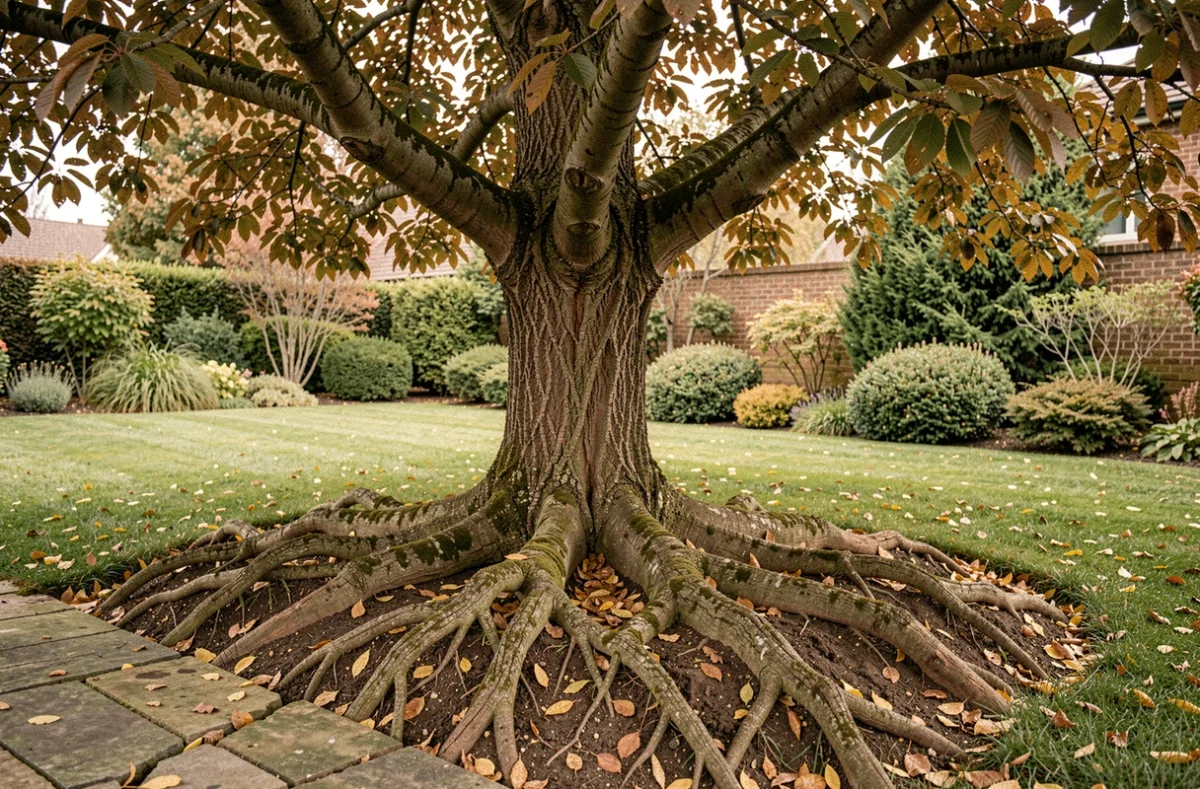
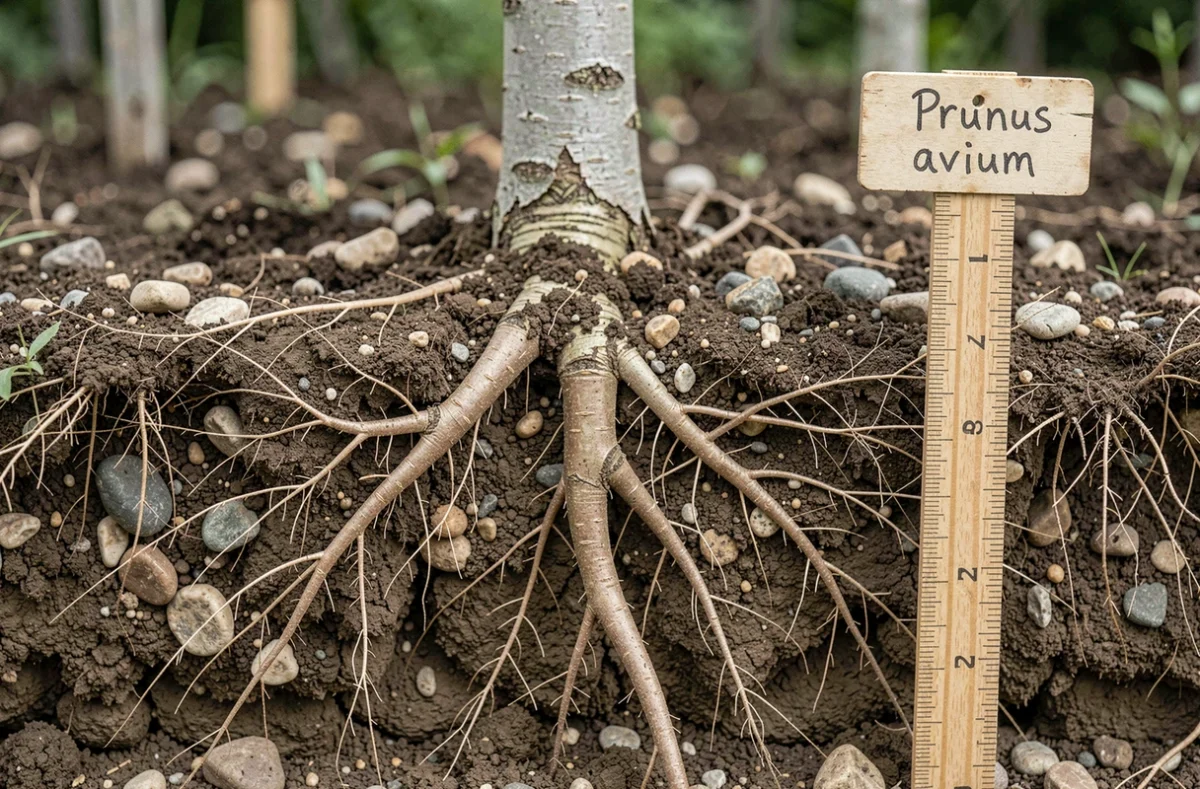
Cherry tree roots do not grow as deep as is often assumed. Most of the root system is concentrated in the upper soil layers, but it can spread laterally well beyond the canopy’s drip line. This is what causes problems near masonry structures, pipes and patios, and why planting decisions need to take more than simple distance into account.
Rootstock, soil and watering: the three factors that shape cherry tree roots
The rootstock affects the tree’s overall vigour, but it cannot, on its own, predict where the roots will grow. A cherry tree grafted onto Gisela 5 (a dwarfing rootstock) develops a more compact root system than one grafted onto a standard wild cherry rootstock, but that does not guarantee it will not spread laterally. Rootstock genetics determine the tree’s potential, not the extent of its root zone.
Soil type changes the picture. In compact clay soil, roots stay close to the surface and spread horizontally, sometimes well beyond the canopy. In deep, sandy soil, they grow further down in search of water. Heterogeneous soil—for example, loose fill next to a foundation footing—creates paths of least resistance that roots will readily colonise.
Localised watering concentrates roots where water is available. In intensive orchards, root growth is noticeably denser beneath irrigated rows, while the spaces between rows remain sparsely colonised. In a garden, placing a drip line on just one side of the trunk will encourage roots to grow in that direction. This is an underused way to manage root growth.
We recommend considering all three factors before planting near a structure. This article on how far cherry tree roots spread complements this analysis by outlining typical ranges for different conditions.
Assessing the actual risk to patios, walls and pipes before taking action
Roots do not break through an intact foundation. However, they can exploit existing cracks, faulty pipe joints or poorly sealed inspection chambers. This distinction fundamentally changes how the problem should be approached: the issue is not the tree itself, but the condition of the structure.
Patios on a concrete slab
A slab poured over a gravel sub-base can withstand cherry tree roots as long as it has no through-cracks. The real risk is to patios laid on pedestals or a sand bed, where joints can be lifted by shallow roots. Planting closer than the mature canopy’s spread increases the risk of this happening.
Boundary walls and retaining walls
A boundary wall with shallow foundations—two or three courses of concrete blocks on a light footing—is vulnerable. Spreading roots exert gradual lateral pressure that can eventually destabilise the structure. A properly founded wall, with footings extending below the frost line, is much more resistant.
Underground pipes
Roots follow loose soil and damp areas. A leaking pipe creates exactly the conditions that attract roots. Before blaming the cherry tree, check that the pipework is watertight. Purdue Extension also recommends having the roots assessed before deciding whether to cut them or remove the tree.
Ways to manage cherry tree roots in the garden
Managing cherry tree roots involves two complementary approaches: physical containment and biological guidance.
Root barriers: installation and limitations
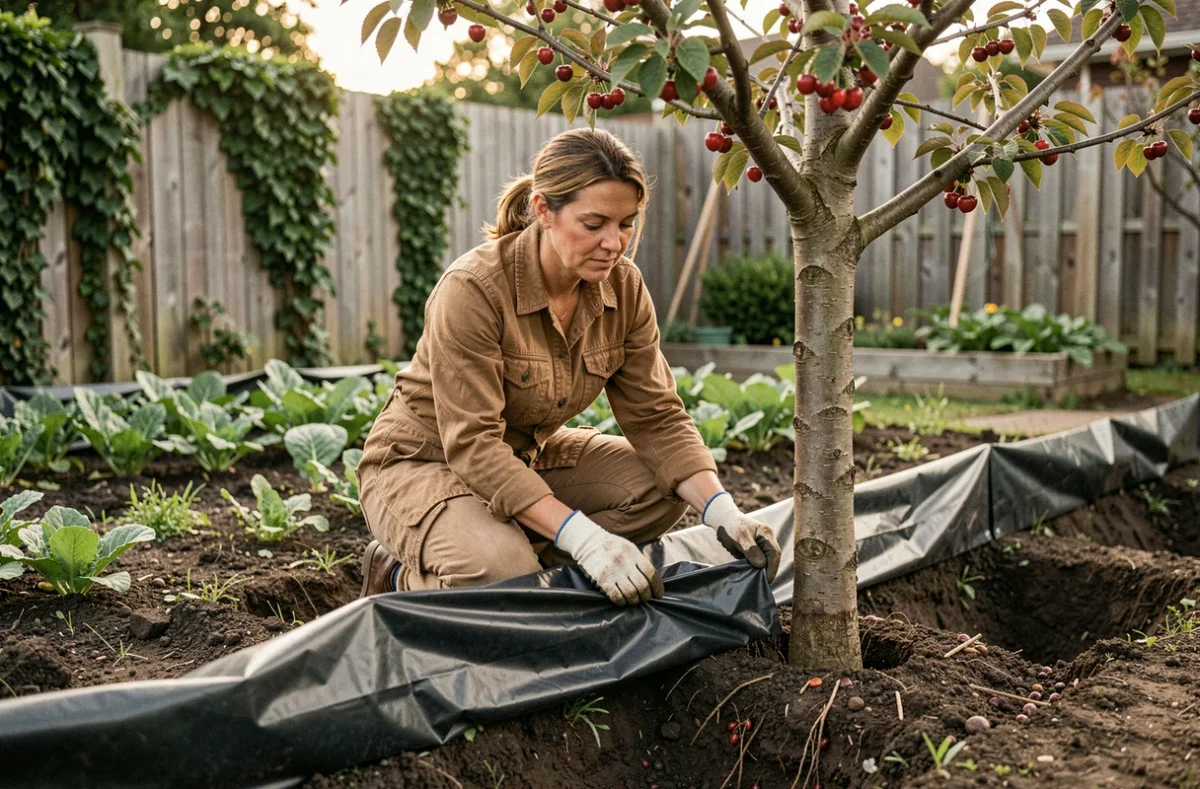
A high-density polyethylene (HDPE) root barrier remains the most reliable way to protect an existing structure. Installation involves a few essential principles:
- Choose a trench depth suited to the soil, extending below the main concentration of roots (the upper soil layers, where most active roots are found)
- Ideally, install the barrier at planting time, when the amount of soil to be moved is still manageable
- Keep it far enough from the trunk to avoid compromising the tree’s anchorage or its ability to absorb water
The main limitation is that a barrier that is not deep enough can be bypassed underneath. It does not eliminate the risk; it shifts it elsewhere.
Using watering to guide root growth
Watering on the side opposite the structure you want to protect encourages roots to grow in the desired direction. This is not a physical barrier, but a biological way to guide root growth over time. Its effectiveness is documented in irrigated orchards, where roots closely follow the areas receiving water.
This technique is less effective in clay soil, where water moves slowly and roots remain shallow regardless of where the tree is watered. The results are more pronounced in free-draining soil.
Pruning cherry tree roots: precautions and timing
Cherry trees do not tolerate severe pruning well, whether above or below ground. Cutting large-diameter roots can expose the tree to gummosis and fungal infections.
The best time is late autumn or winter, outside the period of active sap flow. A clean cut with a saw (not a mechanical shovel) encourages healing. After pruning, a thick layer of mulch over the cut area helps reduce water stress.
If roots have already entered an inspection chamber or a cracked pipe, cutting them without repairing the structure will not solve the problem. New growth will head back towards the source of moisture. The logical order is to repair the leak, install a barrier, then prune the roots that have grown into the structure.
Planting distance is the easiest factor to control, provided you plan ahead. A cherry tree on a vigorous rootstock planted less than three metres from a lightweight wall will eventually cause problems, regardless of the barrier installed. Choosing the right rootstock and planting distance from the outset costs less than any remedial work.