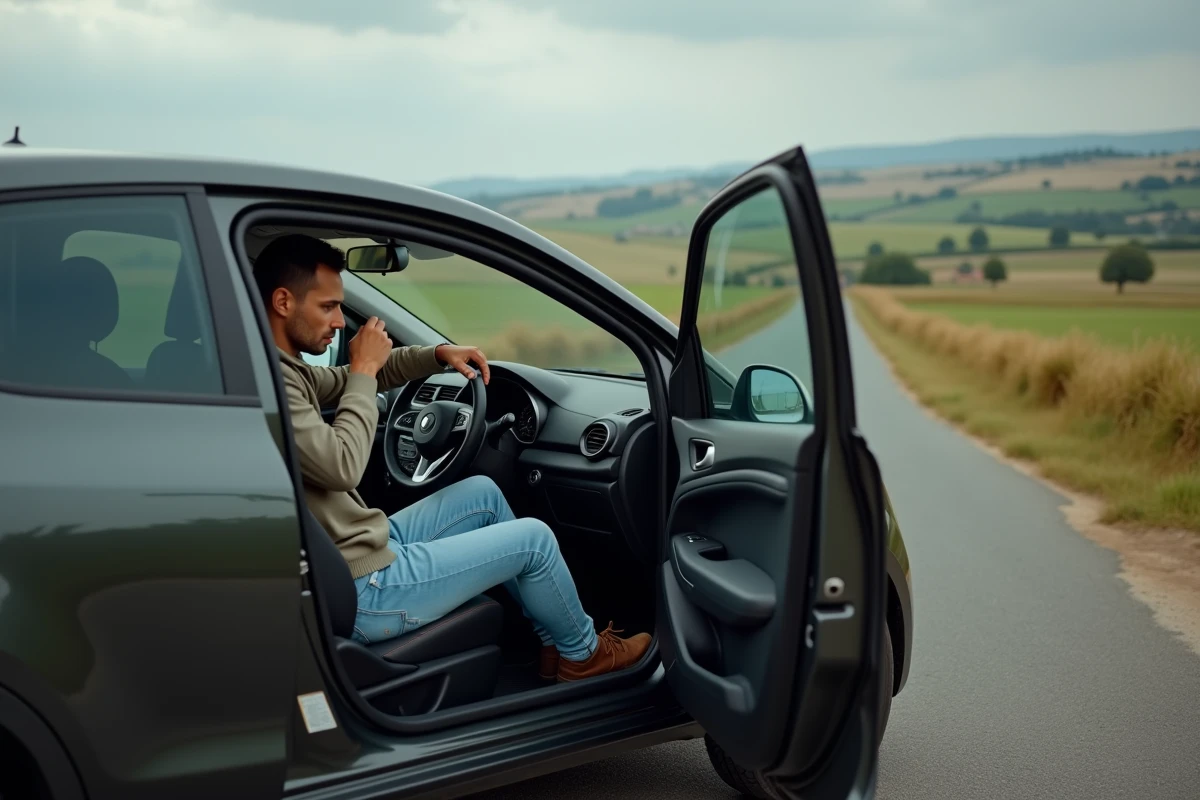
On a Clio 3, the warning signal doesn’t come out of nowhere: when it lights up, there are less than 7 liters left in the tank, which is barely 10 to 15% of its capacity. However, try to find an official distance to travel on reserve and you’ll quickly encounter technical ambiguity: depending on the engine version and the road profile, the margin can vary by 20 kilometers. This can blur certainties.
Getting into the habit of driving on low fuel opens the door to premature wear of the fuel pump. Impurities then find their way into the system, and running out of fuel is no longer the only risk: the mechanical bill can rise much higher.
How many kilometers can you really travel on reserve in a Clio 3?
The Renault Clio 3 is equipped with a 55-liter tank. When the reserve light comes on, there are between 5 and 10 liters left to complete the journey. This light is not insignificant: it warns that the reserve capacity is dwindling, and the margin for error is decreasing. According to manufacturer figures and user feedback, the reserve range of the Clio 3 often fluctuates between 50 and 80 kilometers, varying according to the actual fuel consumption, which is itself dictated by the type of journey and engine.
To provide a reference, here are different consumption values observed on the model:
- Urban consumption: around 5.2 l/100 km
- Extra-urban consumption: 4 l/100 km
- Mixed consumption: 4.4 l/100 km
The reserve never offers a total guarantee. Extreme weather conditions, an overloaded trunk, or under-inflated tires can reduce the range by up to 30%. On the highway and at a good pace, the distance diminishes rapidly. The engine type, whether it’s the SCe 65, TCe 90, or dCi 100, also plays a role, as does the overall condition of the car.
The temptation to push the reserve exposes you to mechanical troubles that are often minimized. The fuel pump, cooled by gasoline, cannot handle levels that are too low: it wears out quickly. The maximum distance to travel on reserve should never be used as an excuse to delay refueling. As soon as the light comes on, think about refueling. For practical tips and detailed feedback, the page dedicated to the reserve range of the Clio 3 remains a useful resource: Reserve range Renault Clio 3: maximum distance and tips – Moteur Mag.
What the reserve light reveals: capacity, safety margin, and factors that change everything
The activation of the reserve light signals a very concrete reality: with a 55-liter tank, the Clio 3 has only 5 to 10 usable liters left. This corresponds to about 10% of the total volume, representing a safety margin designed to prevent running out of fuel, but not to indefinitely delay a stop at the station.
This reserve ideally allows you to travel between 50 and 100 kilometers, but this estimate depends on many parameters that are rarely constant. The maintenance of the vehicle has an immediate impact on the range: clean filters, proper tire pressure, a well-tuned engine, every detail counts. Conversely, under-inflated tires, a dirty filter, or an overload can reduce the possible distance, sometimes by 30%.
Driving behavior makes all the difference: rapid accelerations, hard braking, full air conditioning, all of this consumes the reserve without warning. Weather conditions also matter: headwinds, cold, excessive heat, all weigh on consumption and chip away at the range. The reserve is neither a joker nor an invitation to take risks. Ideally, plan to refuel as soon as the needle touches a quarter of the tank, to spare the mechanics and your own peace of mind.

Mechanical risks and tips to avoid running out of fuel in your Clio 3
Driving on reserve is not just about the stress of an unexpected stop. In the Renault Clio 3, the lower the fuel level, the more the engine is exposed to impurities and air sucked in by the pump. These impurities settle at the bottom of the tank and risk clogging the fuel filter and injectors.
The diesel engine of the Clio 3 is particularly sensitive: air intake, which is common when the reserve is running low, can cause the circuit to lose prime and lead to a sudden stop. In gasoline engines, the problem also exists: the fuel pump needs a sufficient level of gasoline to stay cool. An almost empty tank promotes overheating and accelerates wear.
In winter, condensation in an almost empty tank facilitates corrosion and the presence of water in the circuit, a real concern for diesel engines.
To limit these risks, here are some actions to adopt:
- Refuel as soon as the light comes on, without delay.
- Regularly check the condition of the fuel filter and injectors.
- Consider using fuel additives when running on a nearly empty tank, to protect the injection system.
- In cold weather, keep the level above a quarter of capacity.
The reserve is not a comprehensive insurance policy. Caution remains the best reflex, especially when a few liters can make all the difference between a smooth arrival and an unexpected breakdown.